Findings could guide the design of light-controlled drugs, smart materials and molecular machines
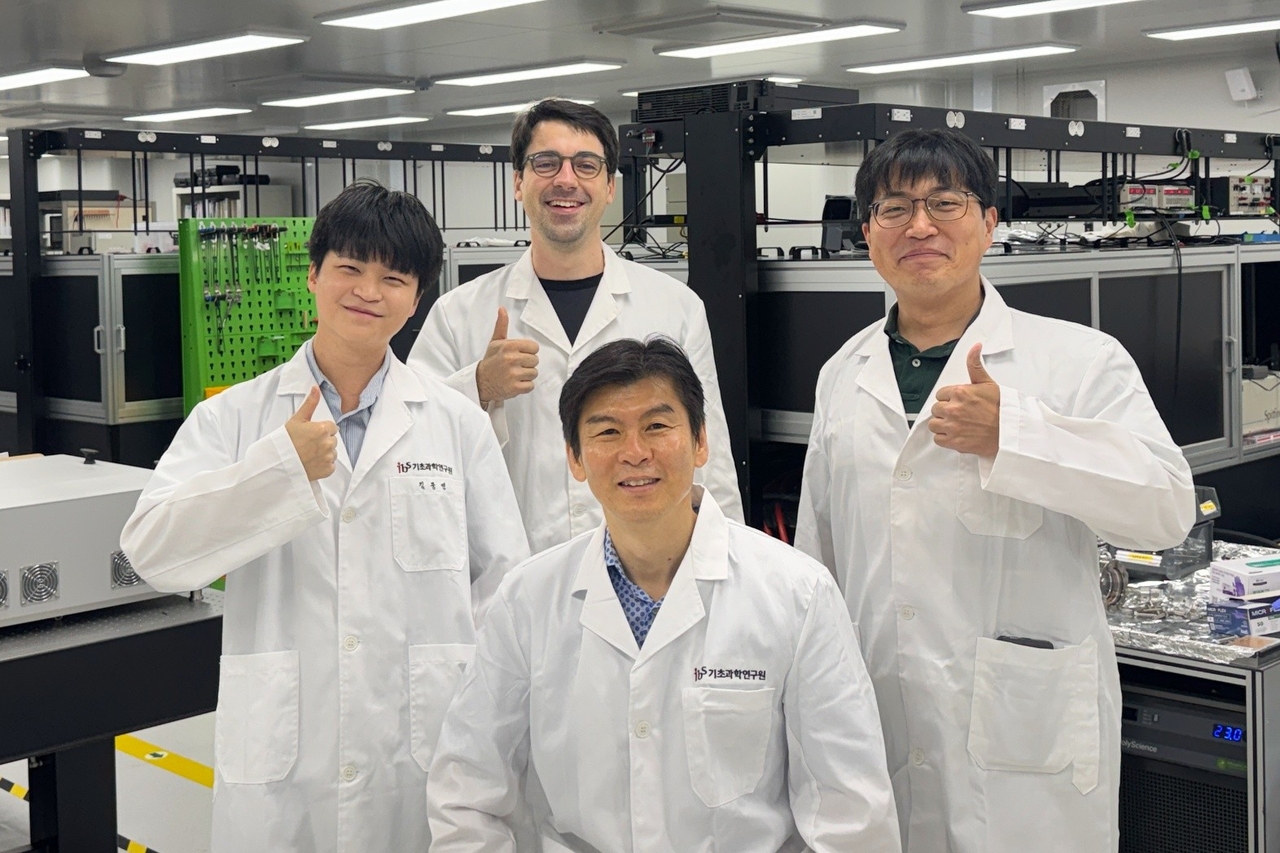
A KAIST research team has tracked how azobenzene, a widely studied molecular switch, changes shape after absorbing light, a finding the researchers said could provide clues for designing light-responsive materials and molecular-scale machines.
The team led by Ihee Hyot-cherl identified how the light-responsive molecule changes its structure, KAIST said Thursday. Ihee is a professor of chemistry at KAIST and director of the Center for Advanced Reaction Dynamics at the Institute for Basic Science.
The KAIST and IBS researchers used ultrafast X-ray pulses to track the structural changes and reconstruct the molecule’s motion as a “molecular movie,” using measurements taken at successive moments to visualize its movement.
Azobenzene consists of two phenyl rings connected by a bridge of two double-bonded nitrogen atoms. The rings can change their position relative each other in response to light, from a "trans" configuration that zig-zags across the bridge to a more u-shaped "cis" structure.
This property has been studied for applications including light-responsive materials, molecular machines and drugs whose activity can be controlled with light. However, precisely how the molecule moves between the two forms has been debated for nearly 50 years.
'Bicycle-pedal' motion key to switch
Researchers used an X-ray free-electron laser at the Pohang Accelerator Laboratory to track the process. They initiated the reaction by irradiating azobenzene dissolved in methanol, then measured changes in its structure over time using ultrafast X-ray pulses.
They found that the two large benzene rings remained almost in place during the initial stage of the transformation.
The reaction began with twisting around the bonds between the rings and each nitrogen atom, followed by a coordinated movement of the central nitrogen bonds resembling the motion of bicycle pedals.
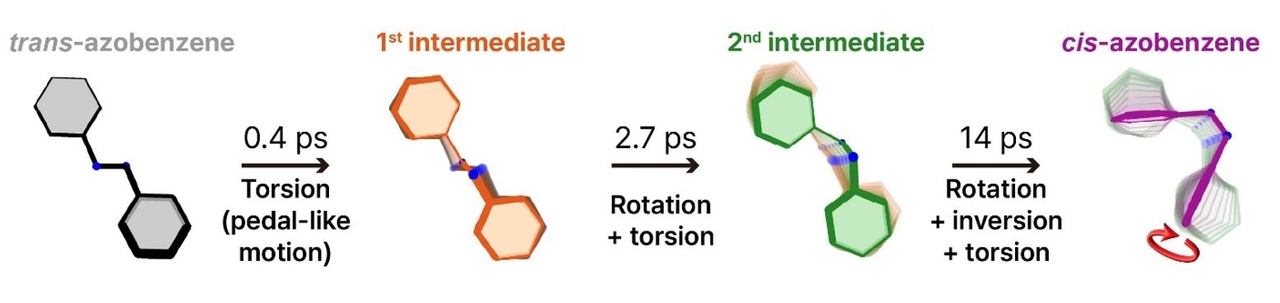
The structural analysis also showed that rotation around the nitrogen-nitrogen bond played a leading role later in the reaction, with an inversion motion making a substantial contribution in the final stage.
The finding helps explain why the reaction rate does not change significantly when the surrounding liquid is more viscous. With the initial motion concentrated in the central part of the molecule, much less liquid needs to be displaced than if the two large rings rotated.
According to the researchers, the study’s significance lies in identifying the pathway the molecule follows as it changes shape, providing basic data that could inform the design of light-responsive materials and molecular machines.
By improving methods for observing rapid movements of organic molecules, the findings could also help researchers understand how a wider range of light-responsive molecules work.
The study, titled “X-ray Liquidography Decodes Complex Motions in Azobenzene Isomerization,” was published online in Nature on Wednesday. It was supported by the Ministry of Science and ICT through the IBS research center program.
minsikyoon@heraldcorp.com